
ConvertfilePlus

AI & Machine Learning

Which is the best free AI for content writing explained with honest comparison of free AI writing tools
AI & Machine Learning

Which Is the Best Free AI for Content Writing? Honest Comparison With Real Limitations

Everywhere you look today, someone is saying “This AI will write perfect content for you”. But when you actually try most of them, the story feels very different. Either the free version is too limited, or the content sounds robotic, or suddenly you hit a paywall just when things start getting useful. That’s why the question which is the best free AI for content writing? is not just common — it’s necessary. If you’re a blogger, student, freelancer, or someone who just wants help writing content without paying, this article is written exactly for you. No hype. No promotions. Just real comparisons, real limitations, and real clarity. By the end, you won’t just know which is the best free AI for content writing, but also why it works, where it fails, and who should actually use it. Read Also : How Does AI Technology Work? Simple Guide for 2026 Why People Are Searching for the Best Free AI for Content Writing Content writing takes time. Real time. And not everyone can sit for hours brainstorming ideas, structuring paragraphs, fixing grammar, and rewriting sentences again and again. This is where AI content writing tools without cost start attracting attention. But here’s the catch. Free tools sound great, but most of them: So when people ask which is the best free AI for content writing, they’re actually asking: “Which tool actually helps me write better content without forcing me to pay?” That’s the mindset we’re working with here. What “Best” Really Means in Free AI Writing Tools Before jumping into tools, one thing needs to be clear. “Best” does not mean perfect. For free AI tools, best usually means: Especially for bloggers, the expectation is simple — help me write faster, not replace my brain. That’s why free AI writing tools for bloggers are judged differently than paid enterprise tools. Best Free AI Content Writing Tools: What We Tested and Compared Now let’s come to the real part. Instead of listing 15 tools just for the sake of it, we focus only on best free AI content writing tools that actually give value without money. Each one below has strengths, weaknesses, and very real limits. 1. ChatGPT (Free Version) Let’s start with the obvious one. For many people asking which is the best free AI for content writing, ChatGPT is the first name that comes to mind. And honestly, for good reason. What it does well For bloggers, it works well as a thinking partner. Real limitations Still, among free AI tools for blog writing, it offers the most flexibility without forcing upgrades every minute. 2. Google Gemini (Free Access) Gemini is another tool people try when searching for AI tools for content writing in 2025. It feels more factual and structured. What works Where it struggles If your writing is data-heavy, Gemini helps.But for storytelling or conversational blogs, it needs polishing. 3. Grammarly AI (Free Features) Grammarly is not a full content generator, but it still plays a role in free AI writing tools for bloggers. What it’s good for Limitations It works best after writing, not before.Think of it as a cleaner, not a writer. 4. Copy.ai (Free Plan) Copy.ai is often mentioned in lists of best free AI content writing tools, but the reality is mixed. Strengths Weak points Good for ideas, not full articles. 5. Rytr (Free Version) Rytr attracts beginners looking for AI content writing tools without cost. What helps Problems Useful for learning, not scaling. Free AI Writing Tools for Bloggers: What Actually Matters Here’s something most articles don’t say clearly. For bloggers, the tool doesn’t need to be magical.It needs to be reliable. When using free AI writing tools for bloggers, these things matter most: Free tools fail when they try to replace the writer instead of supporting them. Which Is the Best Free AI for Content Writing (Based on Real Use) Now let’s answer the question directly. If someone asks which is the best free AI for content writing, the most balanced answer is: ChatGPT (Free version) Not because it’s perfect — but because: In 2025, among all AI tools for content writing, ChatGPT still gives the best value-to-limit ratio. Why Free AI Tools Still Need Human Touch This part is important. Even the best free AI content writing tools cannot: That’s why AI should assist, not replace. The best blogs are still written when: This balance is exactly what Google prefers today. Free AI Tools for Blog Writing: A Simple Comparison Without Hype Instead of fancy tables and marketing words, let’s keep this simple and human. When people search which is the best free AI for content writing, they usually want a quick mental comparison like this: So here’s a realistic comparison in words, not marketing language. From a blogger’s perspective, free AI tools for blog writing should support thinking, not block it. That’s where most tools fail. Hidden Limitations of Free AI Content Writing Tools (Nobody Talks About This) This part matters a lot. Most articles praising AI tools for content writing in 2025 quietly ignore the downsides. But if you’re actually using free tools, you’ll notice these issues quickly. 1. Free Plans Are Designed to Frustrate Most tools give just enough value to make you want more.Word limits, daily caps, or feature locks are very common. This is why many AI content writing tools without cost feel useful on day one and annoying by day five. 2. Output Starts Sounding the Same Free AI tools often rely on fixed templates.After a while, sentences feel predictable and flat. That’s why bloggers who depend fully on AI struggle to stand out. 3. AI Doesn’t Understand Context Like Humans AI can write sentences, but it doesn’t feel the topic. It doesn’t know: So if you don’t guide it well, the content stays shallow. How Bloggers Should Actually Use Free AI Writing Tools This is where most people go wrong. They expect AI to write a full blog perfectly.That expectation kills quality. Here’s the
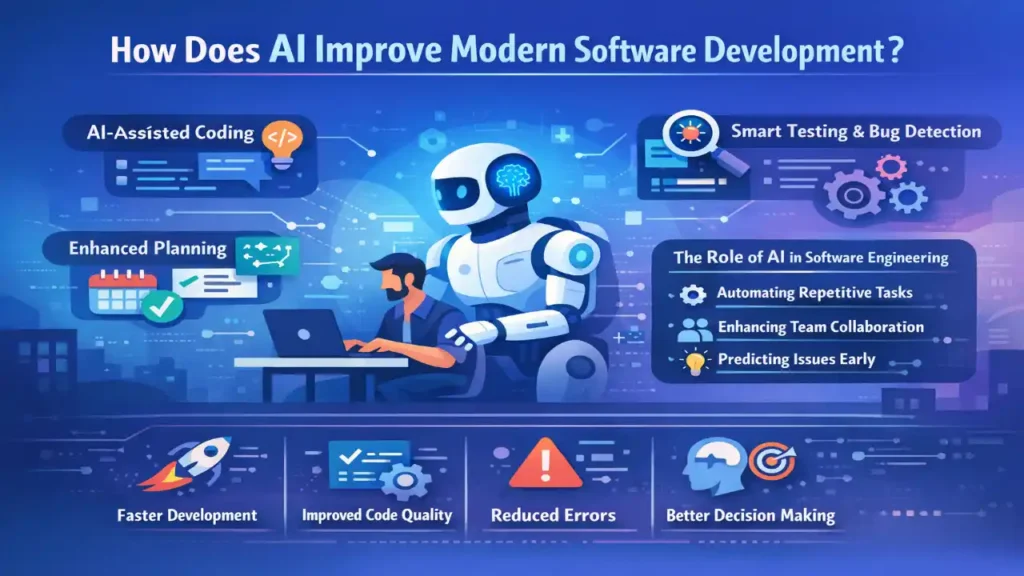

AI improving modern software development with assisted coding, automated testing, smarter planning, and better decision-making.
AI & Machine Learning

How Does AI Improve Modern Software Development?

Introduction: Why Everyone Is Talking About AI in Development If you’ve been around software development for even a few years, you’ve probably noticed something. Things are moving faster. Deadlines are tighter. Expectations are higher. And somehow, teams are still expected to ship clean, stable software. This is where the real question comes in — how does AI improve modern software development, not in theory, but in real day-to-day work? AI is no longer some future concept or experimental idea. It’s already sitting inside coding tools, testing systems, project planning, and even documentation. Developers may not always notice it, but it’s quietly changing how software gets built, reviewed, tested, and maintained. In this blog, I’ll break things down simply. No hype. No sales talk. Just a clear explanation of the role of artificial intelligence in software development, where it actually helps, and why so many teams are adopting it. Read Also : Which Is the Most Popular AI Tool in 2025? Understanding AI in Software Development (In Simple Words) Before jumping into benefits, let’s clear one thing up. AI in software development does not mean machines replacing developers. That fear gets repeated a lot, but it misses the point. AI works more like an assistant. It studies patterns, learns from data, and helps developers make better decisions faster. Whether it’s suggesting code, finding bugs, or predicting issues before they happen, AI is there to reduce manual effort, not remove human thinking. In modern workflows, AI supports developers in areas where repetition, speed, and accuracy matter most. And honestly, that’s where most teams struggle. How Artificial Intelligence Enhances the Software Development Lifecycle One big reason AI fits so well into development is because software follows a lifecycle. From idea to launch, there are multiple stages. AI helps at almost every step. Planning and Requirement Analysis Becomes Smarter Early-stage planning often feels messy. Requirements change. Stakeholders say one thing today and another tomorrow. AI helps teams analyze historical data, user behavior, and previous project outcomes to spot patterns early. This improves estimation accuracy and reduces surprises later. Small improvement here saves a lot of trouble later. AI-Assisted Coding Improves Speed and Accuracy This is probably the most visible area where AI improves modern software development. AI-powered coding assistants analyze context and suggest code snippets in real time. Instead of searching documentation or rewriting common logic again and again, developers get suggestions instantly. This doesn’t remove thinking. It removes friction. And when friction is reduced, developers focus more on logic and architecture rather than syntax. Smarter Code Reviews with AI Support Code reviews are important, but they’re also time-consuming. AI can scan code for: This allows human reviewers to focus on logic, design, and edge cases instead of basic mistakes. That balance improves code quality without slowing teams down. Benefits of AI in Software Engineering You Can Actually Feel Now let’s talk clearly about the benefits of AI in software engineering, not abstract ones, but real improvements developers notice. Faster Development Without Cutting Corners Speed matters, but not at the cost of quality. AI helps teams write, test, and review code faster without skipping best practices. Automated suggestions and testing reduce manual workload while keeping standards intact. That’s a rare win-win in software projects. Reduced Human Error in Critical Areas No matter how experienced a developer is, mistakes happen. AI tools catch patterns humans miss, especially in large codebases. From memory leaks to logical flaws, AI reduces the risk of silent failures. This leads to more stable releases and fewer late-night emergency fixes. Better Focus on Problem-Solving Developers didn’t choose this career to rename variables or fix formatting issues. By handling repetitive tasks, AI frees mental space. Teams can focus on architecture, scalability, and user experience — the things that actually define good software. This shift alone improves job satisfaction and product quality. Role of Artificial Intelligence in Software Development Beyond Coding Many people think AI’s role ends at writing code. That’s not true. The role of artificial intelligence in software development extends much further. AI in Automated Testing and Quality Assurance Testing often delays releases. AI-based testing tools automatically generate test cases, predict high-risk areas, and adapt tests when code changes. This reduces regression bugs and speeds up validation cycles. More coverage, less effort — that’s the real value here. Predictive Bug Detection and Maintenance Instead of reacting to bugs after users complain, AI helps teams act earlier. By analyzing usage patterns and logs, AI predicts where issues are likely to appear. This allows teams to fix problems before they turn into outages. Preventive maintenance is one of the most underrated benefits of AI. Documentation and Knowledge Management Let’s be honest. Documentation is often outdated or incomplete. AI can generate summaries, explain code logic, and help onboard new developers faster. When knowledge stays accessible, teams move smoothly even when people change. That stability matters more than people realize. Why AI Improves Collaboration in Modern Development Teams Software development is not just about writing code alone. AI improves communication by: This keeps everyone aligned and reduces confusion, especially in remote teams. Clear communication means fewer misunderstandings and smoother delivery. Human Developers Still Matter (More Than Ever) Here’s an important point. Even though AI improves modern software development, it doesn’t replace creativity, judgment, or responsibility. AI doesn’t understand business context the way humans do. It doesn’t feel user frustration or product vision. Developers still make final decisions. AI just helps them make better ones. Common Misconceptions About AI in Software Development Some misunderstandings keep floating around, so let’s clear them quickly. What it does is support, enhance, and accelerate development workflows. Once teams accept this, adoption becomes easier. How AI Fits into the Future of Software Development Looking ahead, AI will become less visible but more powerful. Instead of flashy tools, we’ll see: The teams that learn to work with AI, not against it, will adapt faster. And that’s the real advantage. Ethical and Security Considerations When Using AI in Development While talking about how AI improves modern software development, we also need to slow down for a second and look

Which is the most popular AI tool in 2025 used by people worldwide
AI & Machine Learning

Which Is the Most Popular AI Tool in 2025? (Usage Data, Trends & Real Adoption)

Introduction: Let’s Be Honest for a Moment AI tools are everywhere right now. Every day, a new tool launches, someone claims it’s “the best,” and suddenly social media is full of hype. But if you’re like most people, you’re probably thinking something very simple: Which is the most popular AI tool?Not the fanciest. Not the most hyped.Just the one people actually use every day. That’s exactly what this blog is about. I’m not here to sell you anything. I’m not here to push one tool over another. I just want to break this down in a normal, human way. No complicated language. No bias. Just real understanding. By the end of this article, you’ll clearly understand: So let’s start from the basics. Read Also : What Is the Difference Between Generative AI and Traditional AI? What Does “Most Popular AI Tool” Really Mean? Before answering which is the most popular AI tool, we need to slow down and define one thing properly. Popularity doesn’t mean: In real life, popularity usually means usage. Popularity in AI Is Measured By: When you look at AI tools from this angle, the picture becomes much clearer. Why People Are Searching “Which Is the Most Popular AI Tool?” in 2025 This question didn’t become popular by accident. In 2025, AI is no longer optional. Students use it. Freelancers use it. Business owners use it. Even people who never cared about tech are using AI in small ways. People are searching this because: So the intent is simple:“Tell me the AI tool most people trust and use.” A Quick Look at the Most Popular AI Tools in 2025 Before naming one clear winner, let’s acknowledge reality. There are many most popular AI tools in 2025, depending on use case. Some tools are great for design. Some for automation. Some for video. Here’s a simple breakdown. Common Categories of Popular AI Tools But even with all these categories, one type of AI tool clearly dominates everyday usage. Which Is the Most Popular AI Tool Overall in 2025? Let’s not overcomplicate this. When we talk about overall usage, global reach, daily activity, and real adoption across industries, ChatGPT clearly stands at the top. Yes, other tools are powerful.Yes, some tools are specialized.But when it comes to pure popularity, ChatGPT is still the most used AI tool in the world in 2025. And this isn’t hype. This is based on how people actually use AI. Why ChatGPT Is Still the Most Popular AI Tool Let me explain this in a very practical way. 1. It Solves Multiple Problems in One Place People don’t want ten different tools. They want one tool that can: ChatGPT does all of this in one interface. That’s a big reason for its popularity. 2. It’s Easy for Non-Technical Users This part matters more than people admit. You don’t need training.You don’t need tutorials.You just type and talk. That simplicity is why millions of people keep coming back. 3. It Fits Into Daily Life Naturally People use ChatGPT for: That’s what makes it the best AI tool for everyday use for most people. Top AI Tools Used Worldwide (Beyond Just One Winner) Even though ChatGPT leads overall, it’s not the only tool people use. Let’s be fair. Here are some top AI tools used worldwide, each popular in its own space. AI Image & Design Tools AI Video & Voice Tools AI Automation Tools These tools are popular, but they usually serve specific audiences, not everyone. Why General-Purpose AI Wins Over Specialized Tools This is an important point. Specialized tools are powerful, but: General-purpose AI tools, like ChatGPT, feel more human and flexible. That’s why they spread faster. Most Popular AI Tools in 2025: Usage vs Hype Let’s talk honestly. Some AI tools look extremely popular on social media. But when you check real usage, the numbers don’t always match the noise. Real Popularity Comes From: Not from: This is where many articles go wrong. They confuse visibility with adoption. Best AI Tool for Everyday Use (From a Normal User’s Perspective) If someone asks me casually:“Which AI tool should I start with?” I don’t give a long list. I give one simple answer. For everyday tasks, learning, writing, thinking, and problem-solving, ChatGPT remains the most practical option. Why? That’s why it keeps ranking as the best AI tool for everyday use, not just in blogs, but in real life. Everyday Scenarios Where Popularity Shows Clearly Think about this: This isn’t theoretical. This is daily behavior. The Future of AI Popularity: Will This Change? Now, an honest thought. Will ChatGPT always remain the most popular AI tool?Maybe not forever. AI is evolving fast. New tools will rise. Some will challenge the top position. But in 2025, based on: ChatGPT still leads clearly. Comparing Popular AI Tools in 2025 (Without Bias) Now, one thing I want to be very clear about. Saying which is the most popular AI tool does not mean other AI tools are useless or weak. It only means popularity is driven by how broadly a tool is used, not how advanced it is in one narrow area. So let’s compare in a very grounded way. General AI Assistants vs Specialized AI Tools This is where the real difference shows up. General AI Assistants Specialized AI Tools Because of this, general AI assistants naturally dominate global usage. That’s one of the biggest reasons why, when people ask which is the most popular AI tool, the answer usually stays the same. Why Trust Matters More Than Features in AI Adoption Here’s something many blogs don’t talk about. People don’t choose AI tools only based on features. They choose them based on trust. Trust comes from: This trust factor plays a massive role in real adoption. That’s why some tools with incredible features still struggle to reach mass popularity. People hesitate to fully rely on them. Familiarity Creates Popularity Once people get comfortable with a tool, they stop experimenting. They don’t want to: This comfort loop keeps the most popular AI tools in 2025 at the top for longer periods. Usage Data vs

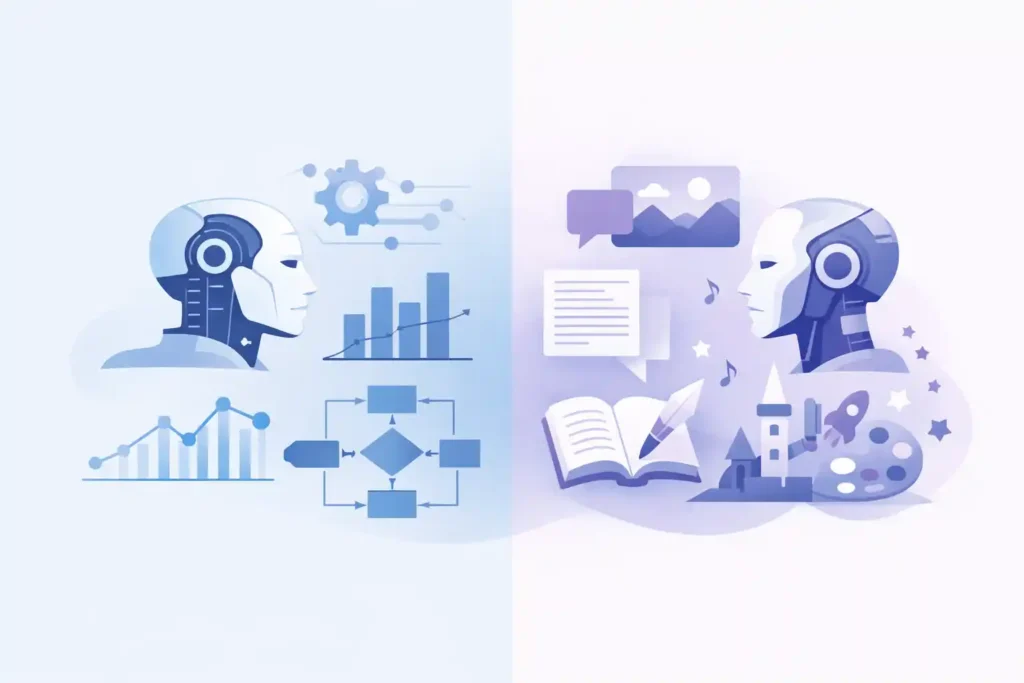
What is the difference between generative AI and traditional AI explained visually
AI & Machine Learning

What Is the Difference Between Generative AI and Traditional AI?

These days, the word AI is heard everywhere.Some people say AI is writing content, some say AI is making decisions, and some say AI will take jobs. But the truth is, not all AI is the same. The biggest confusion is this:What is the difference between generative AI and traditional AI? Many people think both are the same.But the way they work, think, and give output is very different. In this blog, I will explain this difference in very simple words.No technical language.Just normal examples, like we are talking. Read Also : AI Agents for Real Estate: Automate Leads & Closings Why People Get Confused Between Generative AI and Traditional AI First, it is important to understand why this confusion happens. The reason is simple: But the similarity ends here. To understand the difference between traditional AI vs generative AI, we must understand both separately. What Is Traditional AI? (Simple Explanation) Traditional AI is the type of AI that works on rules, patterns, and predefined logic. Its main work is: Traditional AI does not create anything new.It only works based on what it is trained to do. That is why many people also call it rule-based AI systems. How Traditional AI Works How traditional AI works – step by step The working process of traditional AI is very straightforward: In this process, AI: That is why traditional AI is placed in the category of data-driven AI models. Examples of Traditional AI Examples of traditional AI you see in daily life You are already using traditional AI, maybe without noticing: In all these cases, AI follows a pattern.It does not create new content, it only makes decisions. What Is Generative AI? (Simple Explanation) Now let’s talk about generative AI. Generative AI is the type of AI that can create new content. Content means: This is where the biggest difference begins. Generative AI does not only make decisions.It creates output that did not exist before. That is why it is also called content-generating AI. How Generative AI Works How generative AI works in simple words The process of generative AI is a little different: The rules are not fixed.The AI responds based on probability and context. That is why sometimes the output can be unpredictable. Examples of Generative AI Examples of generative AI that many people now know Generative AI examples are now very popular: Traditional AI could never do these things. Generative AI vs Traditional AI: Core Difference Now let’s talk directly. Generative AI vs traditional AI – main difference The simplest comparison is this: Traditional AI says:“This is right or wrong.” Generative AI says:“Let me create something new.” This one line clearly explains what is the difference between generative AI and traditional AI. Traditional AI vs Generative AI in Decision Making Also Traditional AI vs generative AI – decision approach Traditional AI: Generative AI: That is why their use cases are different. Machine Learning vs Generative Models (Short Understanding) Traditional AI mostly uses machine learning models that focus on classification and prediction. Generative AI uses generative models that focus on creation. This difference clears a lot of confusion. Where Traditional AI Is Still Better Generative AI is not best everywhere. Traditional AI is better when: That is why traditional AI is still strong in areas like banking and healthcare. Where Generative AI Is Clearly Better Now let’s be direct. Generative AI is not perfect everywhere, but in some areas it is clearly ahead of traditional AI. Generative AI is better when: Traditional AI struggles here because it is built for decisions, not creation. This is where what is the difference between generative AI and traditional AI becomes even clearer. Generative AI vs Traditional AI: Use Case Comparison Generative AI vs traditional AI – real-life use Let’s break it down simply. Traditional AI is used when: Generative AI is used when: Both have different roles, and they do not replace each other. Examples of Generative AI vs Examples of Traditional AI Side-by-side simple examples Examples of traditional AI: Examples of generative AI: This clearly shows that traditional AI vs generative AI is used in very different ways. How Traditional AI and Generative AI Learn Differently How traditional AI works (learning style) Traditional AI: That is why traditional AI is stable but not flexible. How generative AI works (learning style) Generative AI: It has more creativity, but sometimes accuracy can be lower. Control vs Creativity: The Real Difference This is an important point that many people miss. Traditional AI = ControlGenerative AI = Creativity Traditional AI: Generative AI: Understanding this balance is very important. Role of Data in Both AI Types Data is important for both, but it is used differently. Traditional AI: Generative AI: That is why generative AI systems are heavier. AI Decision-Making Systems: Where Each Fits Traditional AI works best when: Generative AI works best when: Here, the difference between machine learning vs generative models becomes practical. Limitations of Traditional AI Traditional AI is powerful, but it has limits: That is why traditional AI alone is not enough for modern problems. Limitations of Generative AI Generative AI is also not perfect: That is why it should not be used blindly. So, Which One Should You Use? This question comes to everyone’s mind. The answer is simple: Both have different roles.They are not competitors, they work together. Future View: Will Generative AI Replace Traditional AI? Short answer: No Long answer:Generative AI will not replace traditional AI. It will work with it. Future systems will mostly be hybrid: This is how future AI will be built. Final Summary: Difference in One Simple Line In one line: Traditional AI decides.Generative AI creates. This clearly explains what is the difference between generative AI and traditional AI. Conclusion Today, understanding AI is important.But understanding it the right way is even more important. Both traditional AI and generative AI are powerful, but their roles are different.If this difference is not clear, confusion will remain. Next time you hear the word AI, pause and think: That clarity is enough. FAQs

Top 10 best autonomous AI in 2026 working independently without human input
AI & Machine Learning

Top 10 Best Autonomous AI in 2026 (That Can Work Without Human Input)

There is a lot of noise around AI these days. Everywhere you look, there are tools, bots, automation, and agents. But honestly, the biggest change in 2026 is not that AI is becoming smarter. The real change is that AI is becoming independent. Earlier, AI was only about “helping humans.”But in 2026, the discussion is about autonomous AI — AI that can think on its own, make decisions on its own, and take action on its own. All this without asking for human approval at every step. That is why today we are talking about the Top 10 best autonomous AI in 2026 — AI systems that can truly work without human input, not just follow commands. I will keep this blog simple. No heavy technical talk. Just practical understanding, like I am talking directly to you. Read Also : AI Agents for Real Estate: Automate Leads & Closings What Does Autonomous AI Really Mean in 2026? First, this needs to be very clear. Not every AI is autonomous.And not every automation is intelligent. Autonomous AI in 2026 means: In simple words — AI that does not just work, but also takes responsibility. Based on this idea, the list below is created. How We Selected the Top 10 Best Autonomous AI in 2026 This list is not random. Some clear criteria were used: These tools and systems are not perfect, but they are far ahead for 2026. Top 10 Best Autonomous AI in 2026 1. Advanced Multi-Agent AI Systems This is not a single AI. Multiple autonomous AI agents work together. Each agent has its own role — planning, execution, checking, and improving. These systems: That is why these systems come at the top of the Top 10 best autonomous AI in 2026 list. 2. Self-Learning AI Tools with Long-Term Memory These are self-learning AI tools that do more than just process data. They also remember. Having memory means: In 2026, such AI tools will be commonly used in: 3. Autonomous AI Agents in 2026 for Task Execution Role of autonomous AI agents in 2026 These AI agents do not just chat.They complete tasks fully. For example: Humans only see the final result. This is how autonomous AI agents in 2026 make workflows smooth. 4. Decision-Making AI for Business Operations Here, AI does not just give suggestions. It takes decisions. For example: Such AI agents for business automation in 2026: And most importantly, they reduce unnecessary meetings 😄 5. Autonomous AI for Customer Support Without Scripts Traditional chatbots follow scripts.Autonomous AI systems work based on context. This AI: In 2026, this will be a strong part of the Top 10 best autonomous AI in 2026, because customer experience matters a lot. 6. Self-Optimizing AI Systems This AI keeps improving itself over time. Features include: Humans do not need to optimize it again and again. That is why the future of self-learning AI tools looks very strong. 7. Autonomous AI in Software Development In 2026, AI will not only suggest code. It will: Developers will act more like controllers, not executors. That is why these systems fit naturally in the Top 10 best autonomous AI in 2026 list. 8. AI Agents for Business Automation at Scale Next level of AI agents for business automation This AI: For small teams, this will be a game changer because work increases but people do not. This category will grow very fast in 2026. 9. Autonomous Research and Analysis AI Research is usually slow.Autonomous AI makes it faster. This AI: Humans only see the final insights. Such self-learning AI tools will be very useful in strategy and planning roles. 10. Goal-Driven Personal Autonomous AI This AI works like a personal digital manager. You give goals like: The AI: This is the next phase of personal autonomy. Why Autonomous AI Is Different from Normal Automation This is very important to understand. Automation means following rules.Autonomous AI means creating and changing rules. That is why the Top 10 best autonomous AI in 2026 are not just tools, but decision systems. Challenges You Should Be Aware Of Autonomous AI is powerful, but not perfect. Some real challenges are: That is why in 2026, smart users will use AI wisely, not blindly. Conclusion: What Will Autonomous AI Change in 2026? In short — In 2026, AI will move from assistant to operator. The Top 10 best autonomous AI in 2026 will not just work. They will: This shift will not be slow.It has already started. Those who understand this now will lead in the future. FAQs

Free vs paid AI photo editing comparison showing which AI is best for editing photos with clear quality difference
AI & Machine Learning, Photography & Image Editing, Tools

Free vs Paid AI Photo Editors: What Actually Changes in Quality? (Hands-on Comparison)

Whenever someone searches which AI is best for editing photos, the real question behind it is not about brands or tools.The real doubt is simple: “Should I use a free AI photo editor, or is paid AI actually worth it?” I’ve seen this confusion everywhere. Some people swear free tools are enough. Others say paid AI changes everything.So instead of hype, let’s slow down and look at what actually changes in quality when you move from free to paid AI photo editors. No promotion.No bias.Just practical, hands-on understanding — the kind you’d expect if a friend was explaining it to you. Read Also : Which AI Is Best for PPT Presentation? Real-Use Guide Understanding the Real Question: Which AI Is Best for Editing Photos? Before jumping into free vs paid, we need to get one thing straight. When people ask which AI is best for editing photos, they are not asking one single thing.Different people want different outcomes. Some want quick fixes.Some want clean professional results.Some just don’t want to learn complex software. That’s why judging AI tools for photo editing only by “free or paid” is incomplete.The quality difference shows up in very specific areas — and that’s what we’ll break down. Free AI Photo Editors: What They Do Well (And Where They Stop) Free AI photo editors have improved a lot. Honestly, much more than people realize. For basic tasks, they can feel almost magical. What Free AI Photo Editors Usually Handle Well Most AI photo editor online tools offer: For casual users, this already feels enough.And for many situations, it is enough. But here’s where the quality line starts showing. The Quality Limit in Free AI Tools for Photo Editing Free tools often rely on simplified AI models. That means: You might not notice this immediately.But once you zoom in or compare side-by-side, the difference becomes obvious. Free AI gives you speed.Not precision. Paid AI Photo Editors: What Changes When Money Is Involved? This is where things get interesting. Paid AI photo editors don’t just remove limitations.They upgrade the thinking depth of the AI itself. That’s the real difference. Better Image Understanding (This Is Big) Paid tools use advanced models trained on higher-quality datasets. What this means in real life: When asking which AI is best for editing photos, this level of understanding matters a lot. Free AI edits what it sees.Paid AI understands what it’s editing. Paid AI Photo Editing Tools Handle Complex Images Better Free tools struggle when images are complicated. For example: Paid AI tools for photo editing usually handle these cases much better. Not perfectly — but clearly better. Free vs Paid: Hands-on Quality Comparison by Task Let’s break this down practically, task by task. No theory.Just outcomes. Image Enhancement – Free vs Paid AI Photo Editors Free AI Enhancement Results Free AI enhancement tools usually: At first glance, images look “better”.But after a second look, they often look artificial. Paid AI Enhancement Results Paid AI editors focus on balance. This is one reason people say paid tools look “professional”, even if they can’t explain why. Background Removal – Free vs Paid AI Photo Editors Free Background Removal Quality Free tools can remove backgrounds quickly. But common issues include: For social media, it might work.For professional use, it often falls short. Paid Background Removal Quality Paid AI tools: If background removal is a priority, this task alone often answers which AI is best for editing photos. Portrait Retouching – Free vs Paid AI Tools for Photo Editing Free AI Retouching Behavior Free portrait tools usually: It’s fast, but noticeable. Paid AI Retouching Behavior Paid AI retouching: This difference matters a lot in portraits, weddings, and profile photos. Object Removal – Free vs Paid AI Photo Editor Online Free Object Removal Free AI can remove simple objects, but: Paid Object Removal Paid AI understands scene context better. This is one area where paid tools clearly show their value. Editing Speed & Consistency Speed matters, especially when editing many photos. Free Tools Paid Tools Consistency is often overlooked, but it’s crucial when deciding which AI is best for editing photos at scale. Control & Customization Differences This is a subtle but important quality factor. Free AI Editors Paid AI Editors Free tools decide for you.Paid tools work with you. Output Resolution & Export Quality Free AI Export Quality Most free tools: Paid AI Export Quality Paid tools: If final image quality matters, this is a big deciding factor. So, Which AI Is Best for Editing Photos — Free or Paid? Here’s the honest answer. There is no single “best” AI for everyone.But there is a best choice for your use case. Free AI Photo Editors Are Best If: Free tools are practical, fast, and accessible. Paid AI Photo Editors Are Best If: Paid tools don’t just add features.They add confidence in the final output. Final Thoughts: The Real Difference Is Not the Price Most people think the difference between free and paid AI photo editors is about locked features. That’s not true. The real difference is quality depth. Free AI edits images.Paid AI understands images. So when someone asks which AI is best for editing photos, the right response is simple: It depends on how much quality actually matters to you. If “good enough” works, free AI is amazing.If “looks right” matters, paid AI makes sense. And now, at least, you know why.

Which AI is best for PPT presentation explained with real-world comparison of AI PPT tools
AI & Machine Learning, Tools

Which AI Is Best for PPT Presentation? (Tested & Compared for Real-World Use)

Let’s be honest for a moment.Making a PPT from scratch is boring, time-consuming, and mentally draining. First you think about content, then design, then alignment, then fonts… and before you know it, half your day is gone. That’s exactly why so many people are now asking one simple question: Which AI is best for PPT presentation? Not because AI sounds fancy.But because people want clarity, speed, and presentations that actually look good — without being a designer. In this blog, I’m not going to hype any tool.I’ll simply explain, in a very practical way, how AI PPT tools work, what they’re actually good at, and which one makes sense for real-world use — whether you’re a student, working professional, or business owner. So let’s start from the basics and move step by step. Read Also : AI Agents for Real Estate: Automate Leads & Closings Why People Are Searching “Which AI Is Best for PPT Presentation?” The intent behind this keyword is very clear. People are not searching for theory.They are searching for a solution. Most users face at least one of these problems: That’s where AI PPT makers enter the picture. Instead of manually designing slides, AI tools help you: But here’s the real issue. Not every AI tool works the same way.And not every AI is suitable for everyone. So asking “Which AI is best for PPT presentation?” actually makes a lot of sense. How AI PPT Makers Actually Work (Simple Explanation) Before choosing the best one, it’s important to understand how these tools function. Most AI presentation tools work in three steps: That’s it. No magic.No guessing.Just automation + smart structuring. Which AI Is Best for PPT Presentation? Key Factors to Decide Instead of jumping directly to names, let’s talk logic. When deciding which AI is best for PPT presentation, you should judge tools on these factors: Ease of Use If a tool is confusing, it defeats the purpose. Content Quality AI should help with: Design Output Slides should look: Flexibility You should be able to: These points matter more than fancy features. Best AI Tools for PPT Presentation (Real-World Comparison) Now let’s talk about what most people really want to know. Below is a practical comparison of how popular AI presentation tools perform in real usage — not marketing promises. AI Tool Type 1: Idea-to-Slides Generators These tools are best when you have: What they do well: Limitations: Best for:Students, beginners, quick presentations AI Tool Type 2: Content + Design Assistants These tools focus on: What they do well: Limitations: Best for:Professionals, teams, business presentations AI Tool Type 3: AI PPT Maker Online Free (Limited Use) Many users specifically search for an AI PPT maker online free. And yes, free tools exist. What they do well: Limitations: Best for:Casual users and students testing AI tools AI Presentation Tools for Students and Professionals (Use-Case Based) This is where most blogs fail.They don’t segment users. Let’s fix that. For Students Students usually need: AI tools help students by: Students don’t need advanced analytics.They need clarity and speed. For Working Professionals Professionals need: AI presentation tools for students and professionals differ here. Professionals benefit from: For Business Owners Business users care about: AI helps here by: Which AI Is Best for PPT Presentation for Real-World Use? Now let’s answer the main question properly. There is no single “best” AI for everyone. But there is a best AI depending on how you use it. If you want speed Choose an AI that: If you want quality Choose an AI that: If you want free access An AI PPT maker online free is okay —But expect limitations. The smartest approach is: That’s where AI performs best. Common Mistakes People Make With AI PPT Tools Let me be very honest here. AI is helpful, but it’s not perfect. Avoid these mistakes: AI should assist you, not replace your thinking. How to Get the Best Results From AI PPT Tools If you really want value from AI, follow this simple approach: AI does the heavy lifting.You do the final polish. That’s the right balance. Future of AI PPT Presentations (What to Expect) AI tools are improving fast. Soon, you’ll see: But still, human judgment will matter. AI can generate slides.Only you know your audience. Final Conclusion: Which AI Is Best for PPT Presentation? So, after everything we discussed, here’s the clear answer. Which AI is best for PPT presentation? The best AI is the one that: For students, simple AI tools are enough.For professionals, structured AI assistants work better.For businesses, design-focused AI tools make the most sense. AI is not here to replace your effort.It’s here to reduce unnecessary work. And when used properly, it can completely change how you create presentations. FAQs

How AI works in agritech industry essay showing smart farming and data driven agriculture
AI & Machine Learning, Tech Trends & Innovations, Tools

How AI Works in the Agritech Industry: A Step-by-Step Essay for Beginners

Agriculture has always been about experience, instincts, and hard work. For generations, farmers relied on weather patterns, soil feel, and seasonal knowledge passed down over time. But things are changing now. Slowly, quietly, and very practically, technology has started entering farms. And at the center of this change is artificial intelligence. This how ai works in agritech industry essay is written for beginners—students, curious readers, or anyone who wants to understand the topic without complex technical language. I’ll walk you through how AI actually works in agriculture, step by step, just like explaining it to a friend. No hype. No promotion. Just clarity. Read Also : AI Agents for Real Estate: Automate Leads & Closings Understanding Artificial Intelligence in Agriculture Before diving into how AI works, it’s important to understand what artificial intelligence really means in farming. Artificial intelligence in agriculture simply refers to machines and software that can analyze data, learn from it, and help farmers make better decisions. It’s not about robots replacing farmers. It’s about assisting them. AI systems look at large amounts of information—like soil data, weather reports, crop images—and then suggest or automate actions based on patterns. So when people talk about AI technology in farming, they’re talking about smart decision-making tools, not science fiction. Why the Agritech Industry Needs AI Agriculture today faces many real problems. Farmers deal with unpredictable weather, rising costs, crop diseases, water shortages, and growing food demand. Managing all this manually is extremely difficult. This is where the role of AI in agritech becomes important. AI helps by: This essay on how AI works in the agritech industry focuses on solving these practical challenges, not just explaining technology. Step 1: Data Collection – The Foundation of AI in Agritech Every AI system starts with data. Without data, AI cannot work. In agriculture, data comes from many sources: This raw data is constantly collected from the field. It might look simple, but this step is the backbone of how AI is used in agriculture. Without accurate data, even the smartest AI system becomes useless. Step 2: Data Processing and Cleaning Once data is collected, it’s usually messy. Some readings may be incorrect. Some information may be missing. AI systems first clean and organize this data so it can be understood properly. This step is quiet but critical. In this phase, AI technology in farming: Many people skip this part, but in reality, this is where most of the work happens Step 3: Machine Learning – Teaching AI to Think Now comes the part where AI starts “learning.” Machine learning allows AI systems to study past data and identify patterns. For example, AI can learn: This learning process improves over time. The more data AI gets, the better it becomes. This is a core concept in every how ai works in agritech industry essay, because learning from data is what makes AI powerful. How AI Is Used in Agriculture for Crop Monitoring AI-Based Crop Health Analysis One of the most common AI applications in agritech is crop monitoring. Using images from drones or cameras, AI systems analyze crop health by detecting color changes, leaf damage, or unusual patterns. This helps farmers: Instead of walking through large fields manually, farmers can rely on AI insights. Early Disease and Pest Detection Crop diseases spread fast. By the time symptoms are visible to the human eye, damage may already be done. AI systems can detect tiny signs of disease early using image recognition. This allows timely action. This practical use of artificial intelligence in agriculture saves both crops and money. How AI Works in Agritech for Soil Management Healthy soil is the base of farming. AI tools analyze soil data to understand: Based on this, AI recommends: This is a simple but powerful example of how AI is used in agriculture to support better planning. AI Technology in Farming for Precision Agriculture Precision agriculture is one of the strongest outcomes of AI adoption. Instead of treating an entire field the same way, AI allows farmers to manage small sections differently. For example: This reduces waste and increases efficiency. That’s why the role of AI in agritech is growing rapidly in modern farming systems. How AI Helps in Irrigation Management Water is one of the most limited resources in agriculture. AI systems analyze weather forecasts, soil moisture data, and crop needs to decide: This avoids overwatering and underwatering. In many regions, AI technology in farming has helped reduce water usage while improving crop health at the same time. AI Applications in Agritech for Yield Prediction Farmers always want to know how much they will harvest. AI models use historical data, weather patterns, and current crop conditions to predict yield. These predictions help farmers: This predictive ability is a major part of how AI works in the agritech industry in real life. How AI Supports Decision-Making in Agriculture AI does not replace human judgment. It supports it. Farmers still make final decisions, but AI provides insights that are difficult to calculate manually. For example: This collaboration between human experience and AI intelligence defines the future of artificial intelligence in agriculture. Challenges of Using AI in Agritech Industry While AI has many benefits, it also comes with challenges. Some common issues include: A balanced how ai works in agritech industry essay must mention these challenges honestly. AI is helpful, but it’s not a magic solution. Future Scope of AI Technology in Farming The future of AI in agriculture looks practical, not dramatic. In the coming years, AI systems will become: We may see better climate adaptation tools and smarter resource management. The goal is not automation for the sake of technology, but sustainability and food security. Why Understanding How AI Works in Agritech Matters Understanding how AI works helps people: This essay on how AI works in the agritech industry aims to simplify the topic so that readers can form their own opinions. Knowledge matters more than buzzwords. Conclusion: A Practical View of AI in Agritech To summarize, AI in agriculture is

AI Agents for Real Estate helping a realtor manage property listings, leads, chat, and scheduling through a smart digital interface
AI & Machine Learning, Tools

AI Agents for Real Estate: How Realtors Are Automating Leads, Follow-Ups & Closings in 2025

Introduction: The Pressure of Real Estate and the Practical Role of AI If you work in real estate, you already know one thing leads do come in, but handling them is the hardest part. Sometimes calls are missed, sometimes WhatsApp replies are late, and sometimes follow-ups are simply forgotten. Then we think, “The lead came, but why didn’t it convert?” In 2025, this exact problem now has a practical solution AI Agents for Real Estate.This is not a future idea. This is a system that many realtors are already using today. In this blog, I will explain in simple words: No hype, no heavy technical words — just real talk. Read Also : How AI Helps in Education: Simple Guide for Students What Are AI Agents for Real Estate? (Simple Explanation) AI Agents for Real Estate means intelligent systems that work like humans, but without getting tired or delayed. They are not just chatbots.They are AI-powered real estate agents that: In simple terms, they work like a Real Estate AI Assistant that operates 24/7 for your business. How AI Agents Work in Real Estate (Step-by-Step) Many people ask, “How do AI agents actually work?”Let’s understand this step by step. 1. Automatic Lead Capture When a user: The AI agent activates immediately.This process is called AI real estate lead generation. 2. Instant Response (24/7) A human agent can be busy, but AI is not.The AI agent replies instantly — day or night. That’s why 24/7 real estate lead response is no longer a luxury. It is now a requirement. 3. Smart Questions and Qualification The AI agent doesn’t just reply with “Hi.”It asks questions like: At this stage, the AI agent qualifies the buyer or seller.This is known as AI agent for buyer qualification and AI agent for seller leads. 4. Follow-Ups Without Forgetting This is where the biggest problem gets solved. The AI agent: This is called real estate lead follow up automation. Why Realtors Are Adopting AI Real Estate Automation in 2025 To be honest, realtors are not using AI because it’s a trend.They are using it because the manual system is failing. Key Reasons: That’s why AI real estate automation is no longer optional. AI Agents for Real Estate Leads: Real-Life Use Cases Enough theory.Let’s look at practical use cases. 1. AI Agent for Property Inquiries When a visitor asks: The AI agent handles everything without human involvement. 2. Real Estate Appointment Scheduling AI The AI agent: This fully automates real estate appointment scheduling AI. 3. AI for Real Estate Customer Support For existing clients, questions like: The AI agent explains everything calmly.This is called AI for real estate customer support. AI Agents vs Real Estate Virtual Assistants This confusion is very common. AI Virtual Assistant for Real Estate AI Agents for Real Estate That’s why, in AI agents vs real estate virtual assistants, AI agents are a more scalable solution. AI Agent vs Human Real Estate Agent (Reality Check) One thing should be very clear. The AI agent: Think of AI agent vs human real estate agent like this:AI handles routine work,Humans build relationships. The best results come when both work together. Benefits of AI Agents in Real Estate Simple and clear points: These are the real benefits of AI agents in real estate that help businesses grow. AI Real Estate Sales Automation: How Closings Improve Closings don’t happen only because of persuasion.Closings happen because of consistency. The AI agent: That’s why AI real estate sales automation directly improves closings. AI Agent for Real Estate Marketing Marketing is not just about running ads. The AI agent: This is known as AI agent for real estate marketing. AI Real Estate CRM Integration (Why It Matters) If an AI agent doesn’t save data, the work is incomplete. With AI real estate CRM integration: This is especially helpful for small teams. AI Tools for Real Estate Agents (Without Naming Brands) Today, there are many AI tools for real estate agents that handle: But more important than tools is workflow clarity. AI Agents for Real Estate Teams & Brokers For bigger teams: That’s why AI agents for real estate teams and AI agents for real estate brokers are being adopted quickly. AI Automation for Real Estate Startups & Small Agencies The good news is:AI is not only for big companies. AI real estate tools for small agencies and AI automation for real estate startups give them a fair chance to compete. Future of AI in Real Estate Industry In the coming time: The future of AI in real estate industry will focus on automation along with trust and transparency. How to Automate Real Estate Business Using AI (Final Thought) Automation does not mean losing control.Automation means: When used correctly, AI agents for real estate make businesses both stable and scalable. Conclusion: AI Agent Is a Tool, Not a Shortcut One honest thought to end with. AI agents are not magic.But when used in the right way, they: In 2025, realtors who grow will be those who understand AI and use it wisely — not blindly. FAQs: AI Agents for Real Estate

A modern light-blue and white themed blog banner showing AI technology graphics with digital neural patterns and ‘AI Technology Explained
AI & Machine Learning

How AI Works Behind the Scenes: The Easiest Explanation You’ll Ever Read

Sometimes when you look at AI, it feels like magic — you press a button and the result appears. But honestly, the process happening inside is very interesting. In this blog, I’m explaining to you in simple, daily-life language how AI actually works behind the scenes… without using complicated technical words. And yes, the blog naturally includes the focus keyword “What is AI technology and how is it used?”, so the SEO stays perfect without sounding forced. Read Also : How AI Helps in Education: Simple Guide for Students What AI Really Is (Understand in Simple Words) You can think of AI like a digital brain — it doesn’t think like humans, but it learns from data. Its main job is to take decisions, understand patterns, and solve problems. That’s why AI is used everywhere, from your phone to online platforms. How AI Works in Real Life (The Practical Side) People think AI is only about robots or future tech, but the truth is that AI silently makes your everyday digital actions smarter. You use AI many times a day without even noticing it. AI in Mobile Phones — More Than You Imagine Your phone’s portrait mode, battery saving features, and even autocorrect — everything works because of AI. It studies your usage patterns and makes your phone more efficient. That’s why the mobile experience feels smooth. AI in Social Media — The Most Active One Your reels feed becoming personalized, fake accounts being detected, and trending content being shown — all of this is done by AI. It studies your activity and shows you the content you like the most. Online Shopping — “Recommended for You” The “You May Like” section on Amazon or Flipkart is the result of AI. It checks your past purchases, searches, and browsing behaviour to guess what you might buy next. Behind the Scenes — How AI Works Internally AI’s internal process may look complex, but in simple words, it learns from data, improves over time, and then gives predictions. These steps together make AI intelligent. 1. Data Collection — The First Step AI needs a lot of data to learn — like images, text, voice, and videos. The more different types of data it gets, the better it learns and the smarter the output becomes. 2.Data Labeling — Teaching AI What the Data Means AI does not automatically know if a picture has a cat or a dog. Humans label the data to teach AI what each image or text means, so the system can understand patterns correctly. 3. Training — Giving AI Its Brain During training, AI processes data again and again, makes mistakes, and then improves. This continuous cycle makes AI smarter with every attempt, without getting tired. 4. Prediction — The Final Output After training is complete, AI starts giving results — like recognizing images, suggesting text, or converting voice to text. This is the part you directly experience as a user. Applications of Artificial Intelligence (Real Examples We Actually Use) AI is now the backbone of almost every industry. From healthcare to business, AI provides speed, accuracy, and automation. It makes daily operations much more efficient. 1. HealthcareAI helps doctors by reading medical reports and detecting diseases early. It also supports personalized treatment decisions. 2. FinanceFinancial systems use AI to detect fraud, secure transactions, and calculate credit scores. It makes banking smarter and safer. 3. EducationAI tools give students personalized study plans. Automated grading and AI tutors reduce the workload of teachers and give better support to students. 4. TransportationGoogle Maps finding the best route, traffic prediction tools, and self-driving cars — all of these run on AI. Transport systems are becoming smoother and safer. 5. Business & AutomationWhether it’s CRM automation or customer chatbots, AI makes business work faster and more cost-effective. Market analysis also becomes easier with AI. Benefits of AI Technology (Straightforward Advantages) 1. Speed & AccuracyAI can process huge amounts of data in seconds and give accurate results. It doesn’t have issues like mood changes or tiredness. 2. Available 24/7AI tools don’t need breaks. They provide consistent performance day and night. This makes 24/7 customer service possible. 3. Saves MoneyWhen repetitive tasks are automated, companies save money on manpower. In the long run, AI becomes a cost-effective solution. 4. Better DecisionsAI gives data-based insights, which help companies and individuals make smarter and more accurate decisions. Future of AI in Daily Life (What’s Coming Next) 1. Hyper-Personalized EverythingIn the future, content, recommendations, and shopping experiences will become extremely personalized — exactly matching your preferences. 2. Smarter Personal AssistantsAI assistants will understand your habits deeply and manage your daily tasks, schedules, and reminders automatically. They will act like digital personal managers. 3. Smart Homes Get SmarterFuture smart homes will understand your routine and automatically manage lights, fans, AC, and security systems — without you doing anything. 4. Improved HealthcareAI will make future diagnosis very early and very accurate. Diseases may be identified even before symptoms appear. Simple Examples to Understand AI (Very Easy Analogy)When YouTube or Instagram shows you 20 similar videos just after you click one, that is AI. It watches your actions and guesses what you might like next. Is AI Dangerous or Useful? (Neutral Answer)AI is just a tool — it can be useful or risky depending on how humans use it. When used responsibly, AI gives accuracy, speed, and convenience. Conclusion — The Simplest Way to Understand AIDon’t think AI is complicated — it is simply a system that learns from data, finds patterns, and gives predictions. It silently works in your daily life and makes tasks easier and smarter. FAQs

Scroll to Top