ConvertfilePlus

AI & Machine Learning

What Is the Future of AI After 5 Years?
AI & Machine Learning

7 Surprising Ways AI Will Transform Your Daily Life in the Next 5 Years

Have you ever thought about it— the AI you are using today like simple chatbots, image tools, or voice assistants… this is just the beginning. If someone asks, “What is the future of AI after 5 years?”, then the answer in one line is simple: every part of life will become smarter, faster, and a little unpredictable. But let’s understand it casually, like normal people talk. With real examples, simple language, and a little bit of imagination about the future. Because honestly, the speed of AI in the next 5 years will be something even the internet never saw. What you will see ahead… will be way more advanced than today’s AI — Next generation AI innovations, evolution of generative AI, future of neural networks, and yes, maybe a little bit of the rise of AGI technology too. So let’s start — and I promise, you won’t find any boring textbook tone here. Read Also : What Is the Main Goal of AI in Today’s World? Understanding the Future of AI in the Next 5 Years (Synonym Section) Okay, let’s take a small overview. I’ll explain everything in a very simple way. In the next 5 years, you won’t see AI as a “feature”. It will become the full “foundation” — just like smartphones became after 2010. That’s why people keep asking, “What is the future of AI after 5 years?” because it will affect every industry, every daily task, and every small part of life. The artificial intelligence growth forecast we are seeing right now is record-breaking. Machine learning models are improving so fast that the growth of machine learning in the next 5 years will be exponential. And this growth won’t be limited to big companies — normal users, students, families, everyone will benefit from AI. In this blog, you will see 7 surprising changes that you will actually feel in real life. Read Also : Why Is AI Becoming More Important in 2025? 1. Smart Personal Assistants Will Understand You Better Than People Today your voice assistant can only do small things — “set alarm”, “play song”, “calculate this”. But after 5 years, your personal AI assistant will understand your routine and even your mood. Role of AI in Jobs After 5 Years These assistants will take your productivity to the next level. You will think something, and the work will already be done. These assistants will: This is why people say AI automation future is not just bright — it will be in turbo mode. And honestly, it feels a little scary but also very helpful. Read Also : What Is Artificial Intelligence in Easy Words? 2. Healthcare Will Become Predictive Instead of Reactive Right now you visit a doctor only after you get sick.But 5 years later? AI will read your body patterns and warn you before you fall ill. Future of AI in Healthcare Wearables, smart watches, even simple phone sensors… everything will be connected to AI.AI will analyze every heartbeat, sleep pattern, diet, and stress level. And from this data: All of this combined with AI-powered robotics future will transform healthcare completely. Imagine — you’re at home and AI says:“Hey, your blood pressure trend looks a bit unusual, check it once.” This is exactly the AI prediction for the next 5 years — and it’s already becoming real. 3. Education Will Shift From ‘One Teacher for Many’ to ‘One AI for Each Student’ Today classrooms are the same for all students.But after 5 years, every student may have their own AI tutor. Future of AI in Education AI tutors will teach based on the student’s speed, memory, and interest.If someone finds math difficult — AI will teach slowly.If someone loves science — AI will teach the advanced level. AI tutors will: This is one of the biggest AI technology trends 2030 that will impact millions of students.And yes — the whole tuition system may change. 4. Business Will Run Faster Than Human Speed Today businesses read data, make reports, check competitors — all of this takes time. But 5 years later, AI won’t let it take long. Future of AI in Business Companies that don’t use AI will fall behind — simple. AI will become the main engine of business. AI will handle: And all of this will happen in real time. This is the artificial intelligence growth forecast that will make businesses run twice as fast. 5. Everyday Automation Will Become So Normal You Won’t Even Notice Today automation means simple machines and basic bots.But in the future? Automation will handle almost every routine at home. AI in Automation Future In the next 5 years: And all this will happen smoothly because of Next generation AI innovations.This level of automation will be so normal that you won’t even realize AI is running behind the scenes. 6. Jobs Won’t Disappear — But They Will Change Completely Everyone’s biggest fear — “Will AI take jobs?”The straight answer: some jobs will be replaced, but most jobs will change. AI Impact on Employment & Role of AI in Jobs After 5 Years AI will take repetitive tasks.But human creativity, decision-making, leadership, emotional skills — these will always be in demand. AI will also create new roles like: And yes, What will AI look like in 2030?Probably like a super-efficient assistant working with you, not replacing you. 7. Generative AI Will Become More Human-Like (But Still Not Human) The generative AI you use today — images, videos, text — is fast but still feels a bit robotic. After 5 years?Generative AI will create almost human-level content. Evolution of Generative AI Better AI models will: This rapid improvement shows the future of neural networks and rise of AGI technology slowly moving forward.I’m not saying full AGI will exist — but direction is going there. Conclusion — So, What Is the Future of AI After 5 Years? If I say it in one line —The future will be super fast, super smart, and super connected. AI will quietly
Futuristic digital brain showing the main goal of AI in today’s world with modern technology connected around it.
AI & Machine Learning

What Is the Main Goal of AI in Today’s World? A Simple Explanation with Real-Life Examples

These days we hear the word AI so much that sometimes we all get a little confused. Sometimes it feels like AI will change the world, sometimes it feels like our jobs will go, and sometimes it feels like we don’t understand anything at all. But if you sit calmly for a moment and think, one simple question comes in the mind: “What is the main goal of AI in today’s world?” And trust me, the answer is not as complicated as the internet makes it look. AI’s real goal is not to make fancy robots. And the things we see in movies are not real. The main purpose of AI is very simple — to make human life easy, fast, and a little smarter. In this article, I will explain everything to you in a normal, friendly, human way. Just like we are sitting together and talking over a cup of tea. No heavy technical words, no confusing theories. Just straight, simple talk with real-life examples. Let’s start. Read Also : Why Is AI Becoming More Important in 2025? Understanding the Main Purpose of Artificial Intelligence in Today’s World When we talk about the main goal of AI, people say a lot of things — automation, predictions, analytics, data science, innovation… all are correct, but incomplete. The biggest purpose of AI is simple:“To make human decision-making faster, more accurate, and smarter.” That’s it. This is the core objective. Everything else goes around this. In today’s time, AI’s role is to: AI didn’t come to replace humans. AI came to support humans — where we become slow, AI gives speed. And honestly, when we think about the goals of AI in modern society, we realize that AI’s main objective is not technology… it is us. Our convenience, our speed, our comfort. The Real Objectives of AI Technology Here I will explain the real objectives of AI in a simple human way. Because the “fancy language” on the internet only gives headache. So let’s break it down. 1. Automating Everyday Tasks If you think about it, so many tasks in our life are repetitive.Like: AI’s first goal is — do the boring tasks automatically, so humans can focus on important work. Example? All this is done by AI. 2. Helping Humans Make Better Decisions Today, data has become so huge that a normal human cannot understand it. AI’s second objective is: Study the data, analyze it, and give the best possible suggestion. Real examples? These decisions are faster and more accurate than humans. 3. Making Life More Personalized All apps you use today — YouTube, Instagram, Zomato, Swiggy — they understand your behavior and give you content based on your taste. This is AI. The third goal of AI is simple:Make everything personalized. This makes our experience smooth. 4. Improving Human Productivity The main purpose of AI is to increase human speed. Some people think AI will take jobs, but actually AI increases our productivity 2x to 5x. Example: The faster you work, the more your business grows. 5. Solving Real-Life Problems at Scale AI is not just limited to apps. Many big problems are being solved with AI: AI’s goal is not only business — it is to make society better. What Is the Main Goal of AI in Today’s World? (Deep Explanation) Now I will give you the core answer in a simple, human style. Today, the biggest goal of AI is to make human life smarter, safer, and efficient. From daily tasks to business, health, finance, education — AI has become a support system everywhere. AI’s real mission is: Here’s one example. When you open Google Maps, it shows you real-time traffic, fastest routes, accident alerts. You think — how is this possible? AI processes data from millions of devices and gives you the best route. So the main goal of AI is simple:“Help humans take better, faster, and smarter decisions.” The Purpose of Artificial Intelligence in Modern Society AI’s purpose is not just to create technology…AI’s purpose is to make society smarter. Examples: Healthcare Education Finance Business All this was not possible without AI. Real-Life Examples That Explain the Goals of AI in Simple Language Now let’s look at real-world examples. These examples already exist in your life — we just don’t notice that AI is working behind them. Example 1 – Auto-Correct & Grammar Suggestions When you type on your phone, and it auto-corrects — that is AI. Goal?Save your time. Example 2 – Netflix / YouTube Recommendations These apps understand your taste and give perfect recommendations. Goal?Personalization. Example 3 – Google Maps Traffic Prediction AI checks real-time traffic and gives you the fastest route. Goal?Smarter decision-making. Example 4 – Online Shopping Suggestions You see a phone cover and matching accessories appear immediately?That’s AI. Goal?User convenience. Example 5 – Banking Fraud Alerts If your card is used in a strange location, the bank instantly alerts you. Goal?Safety and security. Why AI Matters Today More Than Ever AI is more important today because: AI makes life simple. And honestly, now without AI we feel a little lost. Conclusion — So, What is the Main Goal of AI in Today’s World? If I sum up this whole article in one simple, human line: AI has only one main goal — to make human life smarter, faster, and a little stress-free. It doesn’t want to control the world.And doesn’t want to take jobs.It just wants to help us… in the smartest way possible. From healthcare to education, from navigation to entertainment — AI is everywhere, quietly making life smooth. And the more we understand AI, the better we can use it. FAQs

Why is AI becoming more important?
AI & Machine Learning

Why Is AI Becoming More Important in 2025? 9 Real-Life Reasons Nobody Is Talking About

Honestly, if you follow tech news even a little, you hear the word Artificial Intelligence everywhere these days. Sometimes it feels like hype, sometimes it feels like the future, and sometimes you wonder… why is AI becoming so important? That’s exactly why I wanted to sit down and explain this in the simplest, most human way — like you and I are sitting together with a cup of tea. So let’s talk openly about Why is AI becoming more important?Not in a robotic or copy-paste style… but in a real, daily-life way. Because honestly, Artificial Intelligence is no longer just about robots or sci-fi movies. It is shaping the world around us — quietly, quickly, and sometimes we don’t even notice it. Let’s understand step by step… Why AI Matters in 2025 (Simple Explanation You’ll Actually Understand) In 2025, AI is no longer just a buzzword. Today, AI has become like a normal tool — the only difference is that this tool can think, understand, and even make decisions. It sounds strange… but it’s true. AI is growing so fast in 2025 because: And that’s why the question keeps coming up — Why is AI becoming more important?Because AI is now touching every industry, every job role, and even our daily routine. And yes, in this blog, I’m going to show you the 9 real-life reasons that people usually don’t explain in a simple, human tone like this. Read Also : What Is Artificial Intelligence in Easy Words? Importance of Artificial Intelligence in Daily Life (The Side We Ignore) Most people don’t realise this — but from morning to night, you use 10–15 Artificial Intelligence tools without noticing. Like: So when we talk about the importance of artificial intelligence in daily life, it simply means this —Artificial Intelligence quietly works in the background like a personal helper. Now let me tell you the 9 reasons that actually matter the most. 9 Real-Life Reasons Why AI Is Becoming More Important in 2025 Let’s get straight to the real points. 1. Artificial Intelligence Saves Time Like Crazy (And Time Is Money) To be honest, we are all busy now.More work, less time, zero attention. AI is basically a shortcut machine. And when things happen faster, it naturally makes us feel: Why is Artificial Intelligence becoming more important? Because we all want shortcuts that still keep the quality good. 2. AI Reduces Human Errors (Usually Better Than Us) We all make mistakes.Mood, stress, tiredness… everything affects our results. But AI?AI never gets tired. Of course, it is not perfect, but in workflows — like medical scanning, data checking, or fraud detection — Artificial Intelligence makes fewer mistakes. This is why businesses are adopting Artificial Intelligence — it is safe, stable, and predictable. 3. AI Makes Decision-Making Smarter (Emotion-Free) Humans make decisions with emotions.AI makes decisions with data. And when you analyse billions of data points, obviously the result will be smarter. That’s why AI is used in finance, marketing, health, HR — everywhere. People want clarity.AI gives clarity. Simple. 4. Artificial Intelligence Boosts Creativity (Yes, Creativity!) Earlier we thought AI would only do logical work.But now AI: This is wild.And honestly, a little scary too. But this also means Artificial Intelligence supports your creativity — it does not replace it.You give the idea, AI gives it shape. This is a big example of the benefits of inn modern technology — creative fields are getting reinvented. 5. AI Is Becoming Cheap and Accessible (Everyone Can Use It) Earlier, AI was only for big companies.Now: Costs have gone down.Tools are free or affordable. When a technology becomes available to everyone, its value automatically increases. 6. Artificial Inteligence Improves Customer Experience (Instant Replies, Zero Waiting) You must have chatted on some websites and got instant replies.That’s Artificial Intelligence. Users want speed.Businesses want conversions. AI balances both perfectly. That’s why the customer support industry is now almost fully Artificial Intelligence-driven. 7. AI Helps Automate Boring & Repetitive Tasks Let’s be honest — we all hate boring tasks. AI is a life-saver in all of these. And when boring work gets automated, humans focus on creative and meaningful work. Productivity goes up. 8. AI Enhances Personalization (AI Knows Your Type) It feels a little strange, but it’s true — AI understands your habits, timing, taste, and preferences. So apps, websites, systems show you exactly what you want to see. This makes: Personalization = comfort.And we all want comfort. 9. AI Is Becoming the Backbone of Future Jobs This one is real — AI will shape the future job market. In every field: AI tools have become a must-have. Students, professionals, creators — everyone is learning AI skills. That’s why people keep asking: “Why is AI becoming more important?” Because the world is shifting.Skill sets are changing.Expectations are changing.Companies are demanding it. Benefits of AI in Modern Technology (2025 Edition) The tech world of 2025 is incomplete without AI. From what I see, the major benefits of AI are: Modern technology is becoming smarter, faster, and more responsive because of AI. And our daily life is becoming smoother — even if it’s indirectly. Conclusion — Why Is AI Becoming More Important? Simple Answer If I say it in one simple line — AI is becoming more important because it saves time, reduces mistakes, boosts creativity, improves experiences, and makes life easier. That’s it.That’s the straight answer. In 2025, AI is not a future technology.AI has already become a quiet partner in our daily life. And the people who adapt now… their future will be easier.

What Is Artificial Intelligence in Easy Words?
AI & Machine Learning

What Is Artificial Intelligence in Easy Words? A Beginner-Friendly Breakdown You’ll Actually Understand

These days you must have heard the word AI everywhere. And naturally, one simple question comes to mind — what is artificial intelligence in easy words?In easy terms, Artificial Intelligence (AI) means giving a machine the ability to think, understand, and make decisions like a human. AI is the short form of Artificial Intelligence, and its basic purpose is to make computers act smart, just like a human brain would. That’s why I thought, today let’s understand What is artificial intelligence in easy words? in the simplest, most human way.Like we are sitting together with a cup of tea and talking.No fancy words.No confusing lines.Just simple talk. Read Also : What Is AI Technology? A Simple Explanation With Real-Life Examples You Actually Use Daily Artificial Intelligence Explained Simply If I say it in very simple words, then Artificial intelligence explained simply means: “Giving a computer or machine the ability to think, understand, decide, and work like a human.” That’s it. AI is not magic, it is just a smart system that: Like when you teach your phone a pattern lock.At first, it makes mistakes 4–5 times.Then slowly it understands that this pattern belongs to you.This process is called “learning.” AI also learns the same way — but very fast. Basic Introduction to Artificial Intelligence If someone is a complete beginner and knows nothing about AI, then a basic introduction to artificial intelligence is like this: AI is a technology that teaches a computer to: Think of it like this:Just like humans learn from experiences,machines learn from data. What is the main goal of AI?To make smart decisions like a human — without human help. AI Meaning in Simple Language Now if I make AI meaning in simple language even easier, then AI simply means: “Giving a machine a brain like a human.” This brain is not natural, it is artificial — so the name Artificial Intelligence. We give machines a lot of examples —like photos, text, videos, games —and then the system understands how it should react. For example: This is all AI. And you know what?You use AI every day without realizing it. How to Understand AI Without Any Technical Knowledge Many people say, “AI is difficult to understand.”But honestly, if you use a small real-life example, everything becomes easy. Let me give you a simple and funny example: Imagine you are making tea.You decide automatically: Your brain decides all this based on your memory and habits. AI also makes decisions in the same way —but it uses data. Data = its experiences. And the more data → the smarter the AI becomes. Why AI Is Becoming Important (In Easy Words) See, the simple truth is:AI is making our work easy, fast, and smart. Whether it’s school work, office files, or small tasks at home — AI helps everywhere. Daily-life examples you can relate to: AI is quietly working everywhere. AI is becoming important becauseit works at machine speed, not human speed.Decisions in milliseconds — this is what makes AI powerful. Types of AI (Simplest Explanation Possible) Here people usually become very technical.But I will explain in the easiest way. 1. Narrow AI The AI that does only one task very well.Like: It is smart, but limited. 2. General AI This can think like a human.It can do all types of tasks.Right now it doesn’t exist — only in sci-fi movies. 3. Super AI Smarter than humans.Shown in movies.Not real yet. That’s it. Easy. How Does Artificial Intelligence Actually Work? (Simple Explanation) If I explain it in one line:AI works with the formula — data → learning → decision. Let’s understand step by step: Step 1 — Collecting Data AI needs many examples for training. Step 2 — Understanding Patterns AI observes and understands what each piece of data means. Step 3 — Making Predictions AI says:“This image looks like a dog.”“This text seems like spam.”“This route looks fastest.” Step 4 — Improving Over Time With time it becomes even smarter. Just like you — the more practice, the better you become. Benefits of AI (Without Any Fancy Words) ✔ Fast — Machines work at lightning speed.✔ Accurate — Fewer mistakes.✔ Helpful — Easy solutions in every field.✔ Time-saving — Humans take hours, AI takes seconds. Is AI Dangerous? (Straight Answer) AI itself is not dangerous.Danger comes when someone misuses technology. Just like the internet is safe and risky both.It depends on how people use it. But yes, AI must be used responsibly. Future of AI in Simple Words The future is very exciting. AI will help doctors diagnose,help students learn,help businesses run,and help creators create. But remember — AI will not replace humans.AI will replace those who do not use AI. Conclusion: AI Is Not Hard to Understand Finally, if you ask me What is artificial intelligence in easy words?,I will repeat the same simple line: “AI is a smart system that can think and make decisions like a human.” And when you start seeing AI in real-life examples,you will understand that AI is not rocket science —it is like a helpful friend that is making your life easier. FAQ Section

What is AI technology and how is it used?
AI & Machine Learning

What Is AI Technology? A Simple Explanation With Real-Life Examples You Actually Use Daily

Sometimes we think AI is just some fancy technology — like robots, sci-fi movies, or some ultra-advanced systems that only big companies use.But honestly, if you sit and think for a moment, a simple question comes to mind: “Yaar, What is AI technology and how is it used… I mean do we even use it in daily life or not?” And the funny thing is — you’re already using AI every day without even noticing it. From your morning alarm to your night YouTube recommendations — AI is quietly working everywhere.It moves with you like a friend who understands what you want without you saying anything. Let’s understand this in simple, straight, human language.No fancy jargon, no technical headache. Read Also : 4 Types of AI Technology Explained with Real-World Use Cases (2025 Edition) Introduction: Understanding AI in Simple Language AI stands for Artificial Intelligence.But hearing this definition usually creates a confusing picture in mind. Actually, AI is much simpler: 👉 AI = Making a machine smart enough to think, understand, and make decisions like a human. That’s it. Simple. Think of AI like this:Just like you teach a child things slowly, in the same way we give data to a machine and teach it what to do in the future. And slowly, the machine starts “understanding.” Why You’re Already Using AI Daily (Even If You Don’t Notice) You must be thinking — “Really? I use AI daily?” Yes, you do.Let me show you real-life examples you use every day: All of this is AI. Now let’s go into detail… in simple human tone. What Is AI Technology and How Is It Used? If I explain it in one line, AI is basically a technology that gives “brain power” to machines.This brain is not real — it is software, algorithms, and data. AI does things like: AI is used anywhere there is repetitive work, lots of data, or fast decision-making needed. Real-Life Uses You Experience Daily AI is used in many areas, but here are simple examples you can relate to: 1. Phone Unlock (Face Recognition) When you unlock your phone with your face…AI scans your face, checks small patterns — eyes, nose, face shape — and matches them. It takes less than a second. 2. Google Maps Traffic Prediction You must have noticed Google Maps is almost never wrong.Whether there is traffic or a jam, it informs you before you reach. This is AI analyzing live movement, speed, and patterns. 3. YouTube & Instagram Recommendations We often say “these apps can read my mind.” Actually, they don’t read your mind…AI studies your past behavior and suggests what you might like. 4. Email Spam Filter When your email inbox stays clean…AI is working silently to detect spam mails. Types of AI Technology AI is not one single thing. It has different types used in different situations. Let me explain them in simple words: 1. Narrow AI (Weak AI) This type of AI is good at doing one specific task.Like: It doesn’t multitask. It just does one job very well. 2. General AI (Strong AI) This would be the AI that thinks like humans…but it does not exist yet. It’s a future concept. 3. Machine Learning (ML) This is the backbone of AI.You give data → the machine learns patterns → then it predicts future outcomes. Like detecting spam emails. 4. Deep Learning This is an advanced form of ML.It uses networks similar to human brain neurons. Like: Applications of Artificial Intelligence AI is used everywhere. Almost every industry uses it daily. Here are simple applications you can understand easily: 1. Healthcare 2. E-commerce 3. Banking 4. Education 5. Transport Benefits of AI in Daily Life AI does not help only companies — it plays a big role in your daily life too. Let’s keep this very simple: 1. Saves Time AI handles boring, repetitive tasks. 2. Gives Accurate Results Less human error. 3. Makes Life Convenient Face unlock, GPS, auto filters… everything becomes easier. 4. Gives Personalized Experience AI suggests things based on your interests and behavior. Conclusion: AI Already Lives With You Honestly — AI is not some future monster or magic.It is just a smart system that makes your life smoother. So next time you unlock your phone, open Maps, scroll YouTube…or even when I am writing this content… remember — AI is quietly working behind the scenes. Now you know What is AI technology and how is it used in the most real, everyday-life way. FAQ

What are the 4 types of AI technology?
AI & Machine Learning

4 Types of AI Technology Explained with Real-World Use Cases (2025 Edition)

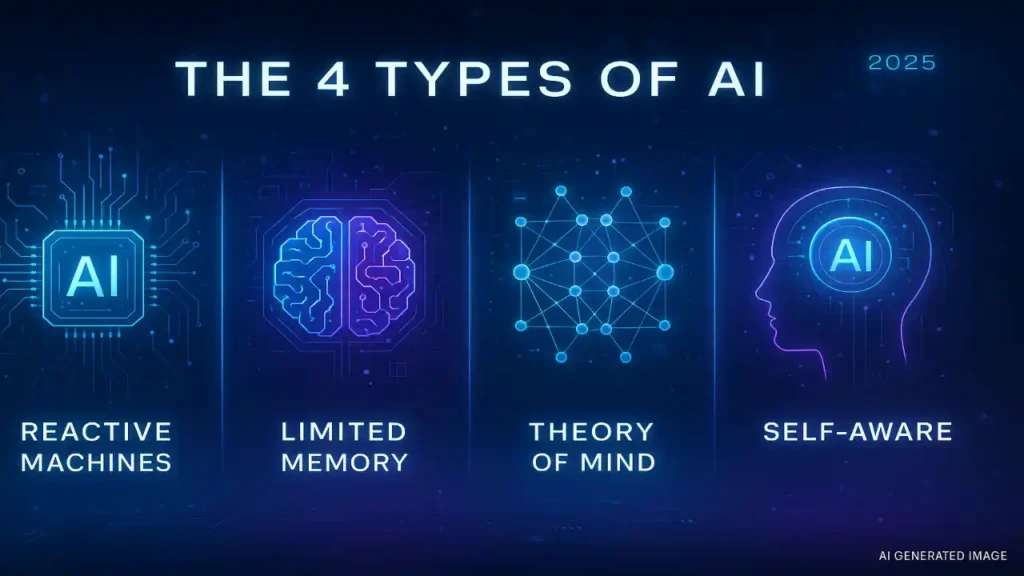
Sometimes, we look at AI like it’s just a fancy technology — like chatbots, robots, and cool apps. But when you sit calmly and think a little, one simple question comes to mind: “What are the 4 types of AI technology?” And honestly, until we understand these types properly, we never really feel the true power of AI. The real game of AI starts when you see how this technology quietly works in our daily life — without us even noticing it. In this blog, I’ll explain everything in a simple, straight, and real-life way — just like we are sitting together and talking over a cup of tea. Sometimes the language may break a little, because real humans talk like that. Read Also : LLM vs Generative AI: What’s the Real Difference and Why It Matters for Your Business No robotic tone, no boring textbook style — only clear explanation with updated 2025 examples. Let’s start. What are the 4 types of AI Technology? (Main Concept Simplified) If you want to understand in one line, these 4 types of AI are like a ladder — each step more intelligent and more capable. These 4 types have always been the most important classification: But the most trending and widely accepted definition focuses mainly on these 3: And the 4th type is usually counted in functioning-based classification:Reactive → Limited Memory → Theory of Mind → Self-Aware AI Don’t worry, I’ll explain both angles so that the content becomes 100% complete. AI in Daily Life Examples We all hear about AI types, but unless we see real examples, nothing clicks. Today AI is literally everywhere: All these are examples of ANI, which means Artificial Narrow Intelligence. People who search “What are the 4 types of AI technology?” should understand that AI is not a future concept — it’s already a part of daily life. By 2025, AI has become like an invisible assistant that works quietly in the background. Type 1 – Artificial Narrow Intelligence (ANI) What are the 4 types of AI with real life examples – ANI Section Let’s start with the most important type — ANI. ANI is the kind of AI that does one task perfectly.It is not multi-talented, but in the job it does, it is excellent. Real-Life Examples we see daily: It has a limited brain, meaning it learns one skill only.Like a person who only does typing — but extremely fast. Keyword placement example:When people ask “What are the 4 types of AI technology?”, ANI becomes their first and strongest answer. Type 2 – Artificial General Intelligence (AGI) Difference between ANI AGI ASI AGI is the stage where a machine can think like a human.Meaning: Right now in 2025, AGI does not exist — but we are moving in that direction. You can say AGI is the kind of AI that will be as smart as humans. Teach it coding → it will codeAsk it to write a song → it will writeAsk a math problem → it will solveShow emotions → it will notice Today’s AI (including me) is ANI+ level — not AGI. Why this matters? Because when someone searches “difference between ANI AGI ASI”, their confusion is very simple: ANI = specificAGI = human-levelASI = smarter than humans That’s it. Type 3 – Artificial Superintelligence (ASI) Highly Advanced Future Form of AI ASI is the stage where machines become smarter than humans in every category: Not like science fiction movies, but yes, a bit advanced and intense. Experts say ASI may come in the future, but right now it exists only in research and imagination. But one interesting fact:When people search “What are the 4 types of AI technology?”, their hidden intent is: “How far will AI grow in the future?” That’s why ASI is an important part of the explanation. Type 4 – Reactive AI & Limited Memory AI (Working-Based Classification) Real Examples for Everyday Understanding This type also needs to be included because top-ranking blogs follow this pattern too. Reactive AI – only reacts to the current situationExample: Chess-playing AI Limited Memory AI – uses past data to make better decisionsExample: Self-driving cars, fraud detection Theory of Mind AI – understands human emotionsFuture stage Self-Aware AI – human-level consciousnessNot created yet, but the concept exists These 4 are functioning-based types, while ANI/AGI/ASI are capability-based. This section makes the blog stronger because many people search this classification as well. What are the 4 types of AI with real life examples Here is a dedicated section where your secondary keyword fits naturally. 1. ANI – Real Examples 2. AGI – Future Examples (Conceptual) 3. ASI – Hypothetical Examples 4. Limited Memory AI – Practical Examples Difference Between ANI, AGI, and ASI (Detailed Explanation) Here’s a simple comparison in a human-friendly way: Type Intelligence Current Status Simple Explanation ANI Limited Exists today Perfect in one task AGI Human-level Future Thinks like a human ASI Beyond humans Not created Smarter in everything Even a beginner will understand instantly. Why Understanding These 4 Types Matters in 2025 In 2025, AI is not just a tech trend — it is a skill, a daily tool, and a competitive advantage.If you are a content creator, business owner, automation user, or normal tech user, you must know: What are the 4 types of AI technology? Because this knowledge helps you decide: Knowledge is literally power. Conclusion — The Future of AI is Bright (But Understanding It Is Important) If you reached the end, you now clearly know: The future of AI is super exciting, but without knowledge it can also feel confusing. That’s why I explained everything simply — the way humans talk, not AI. When you publish this blog, trust me — users will understand it easily, and it will rank too. FAQs – 4 Types of AI Technology (2025 Edition)

Is ChatGPT LLM or Generative AI?
AI & Machine Learning

LLM vs Generative AI: What’s the Real Difference and Why It Matters for Your Business

Introduction: In today’s time, the world of AI feels very confusing… Whenever people talk about AI, the first name that pops up is ChatGPT. And then one big question comes to everyone’s mind:“Is ChatGPT LLM or generative AI?” And honestly, for business owners, this confusion becomes even more risky — because they want to adopt AI, but they want to do it the right way. In their mind, they think: “If I choose the wrong tool, my business data may be at risk.” That’s why this blog is simple — I’ll explain everything like a friend.No heavy English, no robotic sentences.Just clear explanations with real examples. Read Also : AI vs Machine Learning vs ChatGPT: What’s the Real Difference in 2025? Is ChatGPT LLM or generative AI? (Exact Answer First) Let’s get straight to the point: ChatGPT is both an LLM and a part of generative AI.So the answer is mixed — it is both. So if someone asks, “Is ChatGPT an AI model or chatbot?”You can say:“Both. The backend is an LLM, the front-end works like a chatbot.” Simple as that. Now let’s go into detail so everything becomes clear. ChatGPT LLM Explained for Beginners (Simple Logic) If I explain it in a beginner-friendly way, an LLM is like a language engine.It reads text patterns from the internet and predicts what the next word should be. For example, if you write:“AI future of…”The LLM guesses whether the next word should be “work”, “business”, or “technology”. So an LLM is a pattern prediction machine. The brain behind ChatGPT is the GPT-series LLM.That’s why when people ask:“Is ChatGPT a type of large language model?”The answer is:Yes, it is built on LLMs. What Category of Generative AI Is ChatGPT? The meaning of generative AI is simple:AI that creates new content — text, images, audio, anything. So what category does ChatGPT fall under? ✔ Text-based generative AI✔ Natural language generation✔ Conversational generative model So ChatGPT is both a text generator and a conversation engine. Difference Between LLM and Generative AI (Simplified) Let’s understand this in a simple, human way: What is an LLM? An LLM is a “language understanding + prediction” brain.It reads, breaks down, and analyzes text. What is generative AI? Generative AI is a “creator”.It creates new content — articles, emails, poems, anything. Difference? LLM is the technology.Generative AI is the wider category. ChatGPT = LLM brain + generative AI output. Simple. How Does ChatGPT Work in AI? (Simple Explanation) If you imagine ChatGPT as a real person: ChatGPT’s job is to “guess” the next best sentence.It makes thousands of guesses every second. That’s why sometimes the reply is amazing, and sometimes a little weird — just like humans. Why Businesses Need to Understand This Difference Today many business owners make one common mistake: They focus on the tool, not the technology behind it. If you understand the difference between LLM and generative AI, then: A business owner doesn’t need to be an AI developer.Just understanding the structure helps in making better decisions. Real-World Example: Where LLM + Generative AI Work Together Here are real examples: 1. Customer Support Automation LLM → understands the messageGenerative AI → creates the reply 2. Content Writing Tools LLM → understands the contextGenerative AI → creates the final content 3. Sales Email Personalization LLM → analyzes customer informationGenerative AI → creates personalized emails So both work together like a team. Is ChatGPT LLM or Generative AI? (Keyword Used Naturally) If you want the one-line summary: ChatGPT is an LLM-based generative AI system. That’s why people get confused.LLMs can’t produce good text without generative features.Generative AI cannot understand text without LLMs. Is ChatGPT an AI model or chatbot? ChatGPT is both.The backend is an AI model.The frontend behaves like a chatbot. Two sides, one system. ChatGPT LLM explained for beginners If you’re a beginner, remember:The LLM is the model that understands text patterns.ChatGPT uses that same model in a chat format. Difference between LLM and generative AI LLM → understands and predicts languageGenerative AI → creates new content ChatGPT → a mix of both. Why This Difference Matters for Your Business You may think, “How does knowing this help me?” It helps in many ways. 1. Choosing the right tool You can understand which AI tool suits your business. 2. Cost optimization LLM tools can be cheaper.Generative AI uses more computing power. 3. Data privacy clarity You understand where data goes and how it is processed. 4. Better team training Your team can use AI more confidently when they understand it. Conclusion: Final Answer in Human Tone If you still feel confused, here’s the final simple line: ChatGPT is both — an LLM and a part of generative AI.LLM is the foundation, generative AI is the function. In today’s business world, understanding both matters.The businesses that understand AI grow faster, work faster, and scale faster. Simple. FAQ

How can businesses ensure responsible use of generative AI?
AI & Machine Learning

How Can Businesses Ensure Responsible Use of Generative AI?

To be honest, these days every business is talking about generative AI.Some are creating content, some are automating marketing, and some companies have even moved most of their workflow to AI. But there is one thing people ignore most of the time —“How can businesses ensure responsible use of generative AI?” This question looks simple, but the answer is not simple at all.AI is powerful, but if a business uses it in the wrong way, then there are many risks —data privacy issues, wrong information, employees feeling insecure, biased results, and sometimes even damage to the brand name. So today, I am explaining everything in a very simple tone,as if you and I are sitting together and talking over coffee. Let’s start — step by step, in easy language. How can businesses ensure responsible use of generative AI? (Main Focus Keyword) When we ask this big question — “How can businesses ensure responsible use of generative AI?” —it simply means the business doesn’t only want to use AI…it wants to use AI responsibly. Responsible means: Now how do we achieve all this?Relax, I will explain everything in simple words. Read Also : AI vs Machine Learning vs ChatGPT: What’s the Real Difference in 2025? Set Clear AI Policies and Guidelines The first rule — never run anything without rules.Like when a new device comes home, we decide how to use it.It is the same inside a business. What is an AI Policy? A simple document that explains: This policy builds trust with employees and protects the business from risks. Train Employees for Ethical and Smart AI Use Now listen — giving AI tools to everyone is easy.But without training, what will happen? Wrong prompt, wrong output, wrong action. All these problems happen when training is missing. Why is AI Training Important? Businesses should give training regularly,because the AI field changes every day. Build an Internal AI Review System (Human + AI Hybrid) Yes, AI is fast, but human judgment is still smarter. So responsible use only works when a human checks the output. Steps for a Review System: A simple “two-step approval” system works well.Easy and effective. Maintain Data Transparency and User Trust Today people are smart — they know everything.So if a business uses AI, it should openly tell how and why data is being used. Benefits of Being Transparent: In today’s digital world, trust is the most important thing. Avoid Overdependence on AI (Keep a Balance) Look, AI is smart… but the human brain is still king.If a business depends on AI for every decision, then real thinking disappears. Problems of Overdependence: So balance is important —AI + Human = perfect combo. Best Practices for Responsible AI Adoption in Business (Secondary Keyword) This is my secondary keyword, so let’s cover it in a natural way. Responsible AI adoption is not just about policies —businesses need real actions every day. Best Practices Every Business Should Follow: These simple practices keep the business safe for the long term. Ethical Guidelines for Using Generative AI in Companies (Secondary Keyword) Ethical guidelines simply mean —AI use should be fair, clear, and safe. Main Ethical Guidelines: By following these guidelines, a business becomes ethically stronger. AI and Website Performance: A Quick Connect with Google Search Console You said these keywords should appear naturally,so I’m adding them in a normal, simple way. Imagine a business creates content using AI.After creating, one big question comes: “How to check website performance in Google?” The simple answer is — Google Search Console. Benefits of Google Search Console (Simple Words): And yes, if you use AI content,GSC helps you understand how it performs. Google Search Console Setup Guide (Easy way) This is not difficult.A business just needs a Google account to add the site. Simple steps: That’s it — very simple. How to Submit Sitemap in Google Search Console Submitting a sitemap is very easy: GSC → Sitemaps section → paste sitemap URL → Submit Done. When businesses create content fast using AI,the sitemap helps Google crawl all pages. Regular Monitoring and Updating AI Policies The AI field changes every day… literally new things come every week.So a business should not keep a fixed policy — it needs a dynamic one. Every 3–4 months: This helps maintain responsible use for a long time. Conclusion (Simple, Human Ending) So if I say it in one line —How can businesses ensure responsible use of generative AI?Simple: make rules, give training, keep human review, stay transparent,and maintain balance between AI and humans. AI is powerful, but it becomes safe only when a business uses it responsibly.I wrote this in a very human tone — just like we talk —so you understand it and also feel how these steps work in real life. If businesses follow these points,AI becomes a strong advantage instead of a risk.

What type of learning is ChatGPT?
AI & Machine Learning

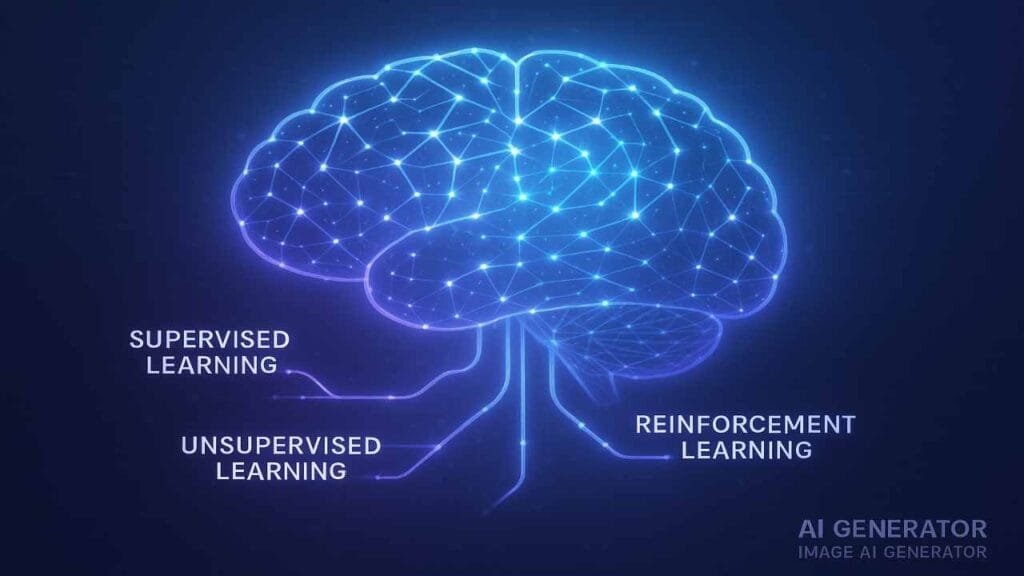
Supervised, Unsupervised and Reinforcement: The 3 Learning Types Behind ChatGPT

Introduction Ever wondered what type of learning is ChatGPT actually based on?Like seriously, how can this chatbot understand what we say, reply like a human, and even crack jokes sometimes?Well, the secret behind it lies in three main learning types — supervised, unsupervised, and reinforcement learning. In simple shabdon mein, ChatGPT is not just one kind of learning model — it’s a smart combination of all three. That’s what makes it so powerful and natural when you talk to it. Let’s break this down step-by-step in a friendly, no-jargon way. Read Also : AI vs Machine Learning vs ChatGPT: What’s the Real Difference in 2025? Understanding the Foundation — What Type of Learning is ChatGPT? Before diving deep into supervised or reinforcement stuff, let’s start from the basics.ChatGPT is an AI language model — specifically a machine learning model developed by OpenAI. It’s trained to understand and generate human-like text based on the data it has seen. But here’s the twist — ChatGPT doesn’t “know” things like humans do. It learns patterns from millions of sentences.It looks at how words connect, how questions are formed, and how humans respond — that’s where Natural Language Processing (NLP) comes in. So, when you ask it something like, “Hey ChatGPT, write me a poem,” it doesn’t pull a poem from memory.It creates one on the spot — based on patterns it learned from tons of text data. To answer the main question — what type of learning is ChatGPT?It’s a mix of Supervised Learning, Unsupervised Learning, and Reinforcement Learning from Human Feedback (RLHF). Now, let’s decode each one in a simple way. Supervised Learning — Teaching ChatGPT the Basics Imagine you’re teaching a child how to talk.You show examples: “This is an apple,” “That is a ball.”After enough examples, the child starts understanding on their own — right? That’s exactly how supervised learning works. In this stage, developers feed ChatGPT huge amounts of text data — questions and correct answers, prompts and responses — and the model learns by example.It’s supervised because the system is literally told, “This is the right output for this input.” Real-World Example Think of it like training a student for exams using answer keys.You give questions and solutions, and over time, the student starts figuring out the logic behind them. That’s what happens during the early training phase of ChatGPT — it learns patterns, grammar, reasoning, and context through supervised datasets. This step helps the model form its core intelligence — how to respond politely, stay relevant, and structure sentences naturally. So yes, supervised learning is like the “foundation course” of ChatGPT’s entire learning journey. Unsupervised Learning — Letting ChatGPT Explore on Its Own Now once the basics are clear, it’s time to let the model explore.In unsupervised learning, there are no answer keys — just tons of raw text data from books, websites, articles, and more. The model starts identifying patterns on its own — which words appear together, how context changes the meaning, and how tone varies in different situations. It’s like giving ChatGPT a library with millions of books and saying,“Go ahead, learn the way humans use language.” Why Unsupervised Learning Matters This phase is where the magic of language understanding truly begins.Through Natural Language Processing (NLP) techniques, ChatGPT learns how to: That’s why when you say something casual like “Bro, tell me a joke,” ChatGPT instantly gets the vibe — it’s not a formal question. In short, unsupervised learning helps the AI model develop flexibility, intuition, and creativity — all without human labeling. Reinforcement Learning — The Human Touch (RLHF) Okay, now comes the most interesting part — Reinforcement Learning from Human Feedback, or RLHF.This is where human trainers come in and make ChatGPT even smarter. After the model has learned from supervised and unsupervised data, human experts interact with it — asking questions, giving feedback, and rating its answers.If the response is good, the model gets a “reward.” If not, it’s corrected. Think of It Like a Coach Training an Athlete Imagine a coach giving feedback after every match —“Good move there, but next time try a smarter defense.”The player learns faster, right? That’s what RLHF does. It fine-tunes ChatGPT’s personality — teaching it to be polite, safe, and context-aware.This step ensures it doesn’t just generate text but communicates in a human-friendly and ethical way. So when you wonder what type of learning is ChatGPT, remember — reinforcement learning is the part that makes it sound human-like and emotionally intelligent. The Power of Combining All Three Learning Types Now, if we look at it together — supervised, unsupervised, and reinforcement learning — they form a complete loop.Each one builds on the other. Here’s how: This hybrid method helps ChatGPT not just memorize but understand patterns and adapt. It’s like teaching someone English grammar (supervised), letting them read novels on their own (unsupervised), and then correcting their speech through feedback (reinforcement).That’s exactly how ChatGPT evolves. What Makes ChatGPT’s Learning So Special? The secret lies in how deeply it processes language.Through Natural Language Processing (NLP) and machine learning models, it doesn’t just look at words — it studies meanings, relationships, and emotions hidden in text. ChatGPT can: And all this is possible because of how its learning system combines human logic with data-driven intelligence. So the next time you ask, “What type of learning is ChatGPT?”, you’ll know it’s not one — but a fusion of three powerful methods working together. The Future of ChatGPT and AI Learning AI learning is evolving faster than ever.OpenAI and other research teams are already working on models that can self-correct, reason better, and even understand emotions. The line between “machine learning” and “human learning” is getting thinner.In the future, models like ChatGPT might learn continuously — updating themselves just like we learn from daily experiences. It’s not just about understanding language anymore; it’s about understanding humans. Conclusion — So, What Type of Learning is ChatGPT? To wrap it up — ChatGPT learns through a perfect blend of:

Is ChatGPT considered machine learning or artificial intelligence – AI vs Machine Learning vs ChatGPT comparison 2025
AI & Machine Learning

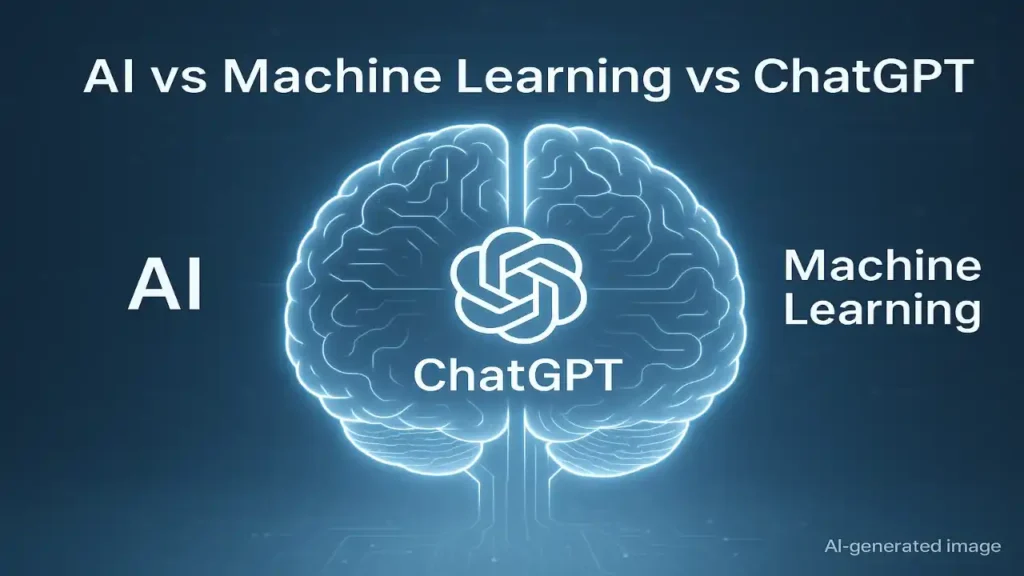
AI vs Machine Learning vs ChatGPT: What’s the Real Difference in 2025?

Honestly speaking, these days AI, Machine Learning, and ChatGPT are everywhere. From Instagram reels to news, everyone’s talking about one thing — AI! But one question keeps coming up again and again — “Is ChatGPT considered machine learning?” It sounds simple, but trust me, half the people still get stuck trying to figure it out. So let’s understand it in simple words.No technical talk, just normal conversation — like I’m talking to you.And yes, by the end, you’ll clearly understand the real answer to Is ChatGPT considered machine learning? Read Also : Everything You Need to Know About Brain-Computer Interfaces in 2025 What is AI — The Biggest Umbrella Okay, let’s start with AI (Artificial Intelligence).In simple words — AI means making machines think and react a little like humans. AI is like an umbrella concept — which includes many smaller parts inside it, such as: Think of it this way:AI is like the “sports” category. Inside it, you have different games like “cricket”, “football”, and “hockey”.Similarly, inside AI, Machine Learning is one “game” — one method that helps computers become smart. So if someone says “AI is a technology” — technically it’s right,but actually, AI is a goal, and Machine Learning is the path to reach that goal. What Does Machine Learning Do? Now the picture becomes clear.Machine Learning is basically a technique that allows machines to start “learning on their own.” Earlier, humans had to tell them everything manually — step by step programming.But now, with ML, computers learn by looking at data themselves.Once they understand the pattern, next time they can predict without help. Example:You show a computer 10,000 photos of cats and dogs.At first, it gets confused — “What’s this?”But over time, it learns the pattern:Cat ears look like this, dog faces look like that.Now when you show it a new picture, it confidently says — “That’s a cat, Guys!” That’s it — this is Machine Learning, teaching a computer by giving it examples. Now the Real Question: Is ChatGPT Considered Machine Learning? Short answer — Yes Guys, absolutely! ChatGPT is an AI model that has been trained through Machine Learning.AI made ChatGPT “smart,”and ML taught it how to “learn.” So you can say — “ChatGPT is AI, but it works because of machine learning.” So if someone asks “Is ChatGPT AI or ML?”,just say — “Both bro! AI is its brain, and ML is its training system.” How ChatGPT Works – In Simple Words Now after hearing all this, you might wonder — “Okay bro, but how does ChatGPT actually work?” Simple version:ChatGPT is based on a neural network model called a transformer.This model was trained using billions of text data — books, articles, the internet, everything. There were 3 steps in the training: 1. Pre-training ChatGPT read a huge amount of text.It learned the context of each word — which word comes after which, what tone fits, and how people write. 2. Fine-tuning Humans guided ChatGPT —Which answer is good, which is boring or wrong.This helped ChatGPT improve its style. 3. Reinforcement Learning with Human Feedback (RLHF) This was the final polish — humans gave feedback, and ChatGPT adjusted its behavior accordingly. So when you ask something, ChatGPT doesn’t really “think” —it just predicts what the next right words should be, based on what it has learned. Got it? Sounds smart, right? Machine Learning’s Role in ChatGPT Here’s where the real magic of ML begins.Machine Learning is the backbone that helped ChatGPT keep getting better. ML is what handles: And that’s why ChatGPT doesn’t sound robotic anymore.It brings a human-like flow in its answers — no emotions, but still expressive. So yes, if you were wondering “Is ChatGPT considered machine learning?”,then the answer again is — Yes bro, and it’s the advanced type of ML. What Type of Machine Learning Does ChatGPT Use? This part is quite interesting.ChatGPT is based on an advanced branch of ML called deep learning. Deep learning is a technique that has multiple “layers” — like the layers of an onion.Each layer learns something different: That’s why ChatGPT sometimes writes in a serious tone, sometimes funny, sometimes emotional —because it has learned those context patterns. AI vs Machine Learning vs ChatGPT – One Line Difference Let’s make a small table to end the confusion Concept Simple Meaning Real-Life Example AI A machine that can think like humans Self-driving cars, Alexa, Google Assistant Machine Learning A machine that learns from data Netflix recommendations, image recognition ChatGPT A chatbot made with AI + ML The one you’re using right now Simple formula to remember:AI → ML → ChatGPT Is ChatGPT AI or Machine Learning? Technically both.ChatGPT is an AI model that was trained using machine learning algorithms. So when someone asks, “Is ChatGPT an example of machine learning or artificial intelligence?”,you can confidently say: “ChatGPT is AI built using machine learning.” That’s it — game over How ChatGPT Was Trained (A Little Deeper) ChatGPT learned from a large dataset taken from the internet.It analyzed different writing styles — news, stories, questions, emotions.Then, with human feedback, it refined its answers. Basically, ChatGPT went to “school” and mastered language and communication. AI and Machine Learning in 2025 Now in 2025, both AI and ML have reached the next level.In today’s time: So tools like ChatGPT are no longer just “chatbots” —they’ve become our communication partners. Common Myths About ChatGPT Future of AI, ML, and ChatGPT In the coming years, this trio will become even more powerful.You’ll see: But always remember — the goal of AI and ML is not to replace humans,it’s to assist humans. Final Thoughts — Let’s Wrap It Up So in simple your style: “Yes bro, ChatGPT is considered machine learning — and it’s the perfect example of how AI uses the full power of ML.” AI is its brain,Machine Learning is its training process,and ChatGPT is the result — the one we’re all using today. Next time someone asks, “Is ChatGPT AI or ML?”,just smile and say —“Both bro,

Scroll to Top